If an emergency happened at your school today, would your staff know what to do?
Not just in a classroom.
Not just on a written test.
Not just because they have a current certification.
Would they know what to do in your school, with your people, in your environment, before professional responders arrive?
That is a different question.
And it is one worth asking.
Training and preparedness are not the same thing
A training certificate can demonstrate that someone successfully completed a course.
It does not necessarily tell us how that person will respond when a real emergency occurs.
Consider a medical emergency in a school.
A student collapses in a classroom.
Who recognizes the emergency?
Who calls 911?
Who begins CPR?
Who retrieves the AED?
Does everyone know where the AED is?
Who brings the first-aid kit or bleeding-control equipment?
Who meets responding EMS?
Who communicates with the administration?
What happens if the employee who normally handles that responsibility is absent?
What happens if an emergency occurs in the gym, on the athletic field, in the cafeteria, on the playground, or during an after-school activity?
These aren’t necessarily questions answered by a certification card.
They are preparedness questions.
Your school is not a classroom
Every school has its own environment.
Your classrooms are different.
Your hallways are different.
Your gym is different.
Your athletic facilities are different.
Your playground is different.
Your staff is different.
Your students are different.
Your emergency equipment may be located differently.
Your communication procedures may be different.
And the challenges your staff face may be different from those of another school just a few miles away.
That’s why we believe emergency preparedness should not begin with a course catalog.
It should begin with a conversation.
What does your school actually need?
At Westshore E.M.R., we don’t believe every organization needs the same training.
We believe the first step is to understand the organization.
What training does your staff already have?
What emergency equipment is available?
Where is it located?
What procedures are already established?
What concerns have your staff identified?
What emergencies are most realistic for your environment?
Where are these opportunities to strengthen preparedness?
And perhaps most importantly:
What does your staff need to feel confident enough to act?
The answers to those questions should help determine the training—not the other way around.
Introducing Westshore EMR School Ready™
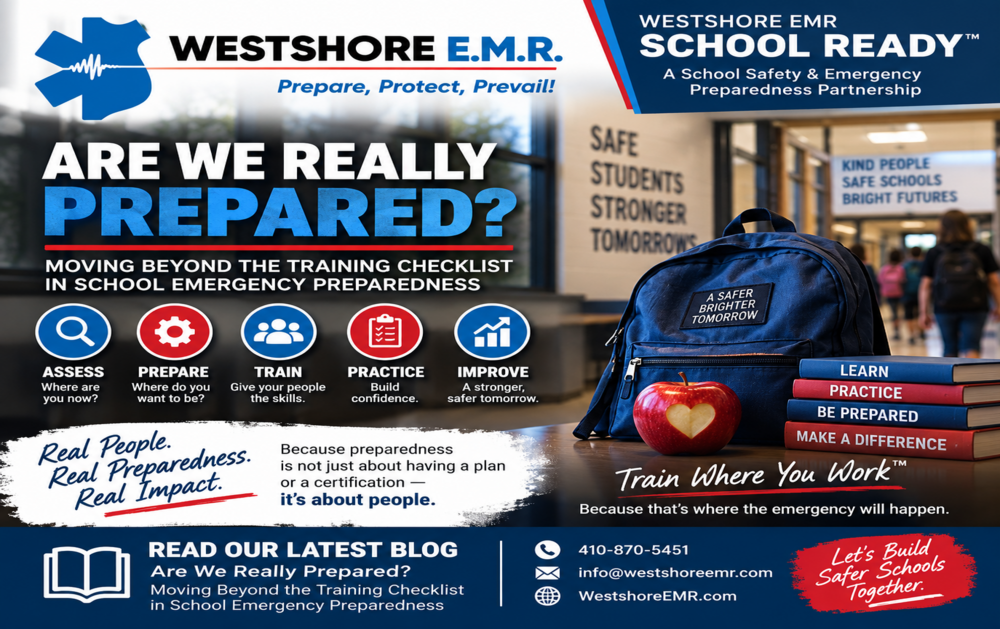
This philosophy is the foundation of the Westshore E.M.R. School Ready™ Program.
School Ready™ is designed as a school safety and emergency preparedness partnership, rather than simply a collection of training courses.
Our approach is built around five steps:
01 — ASSESS
Where are you now?
We begin by learning about your school’s current emergency-response capabilities, staff training, equipment, procedures, and preparedness goals.
02 — PREPARE
Where do you want to be?
Together, we identify priorities and practical opportunities for improvement.
03 — TRAIN
Give your people the skills.
Training may include CPR/AED, First Aid, Active Threat, Stop the Bleed, emergency response, personal safety, situational awareness, and other programs based on the school’s needs.
04 — PRACTICE
Build confidence.
Appropriate scenario-based exercises can help staff take what they’ve learned and apply it within the environment where they actually work.
05 — IMPROVE
Preparedness doesn’t end when a certificate expires.
Emergency preparedness should be reviewed, practiced, and maintained.
School Ready™ can help organizations develop an ongoing approach to training, equipment readiness, review, and preparedness.
Train Where You Work™
One of the principles behind School Ready™ is simple:
Train where you work—because that’s where the emergency will happen.
A classroom environment can teach important skills.
But there is additional value in helping staff understand how those skills apply to their own environment.
Where is the AED?
How long might it take to reach it?
Who knows where the emergency equipment is?
How will staff communicate?
Where will responding emergency personnel enter?
What obstacles might exist?
Who is responsible for what?
These are the practical considerations that can turn knowledge into action.
That’s why Westshore E.M.R. can bring training directly to the organization whenever appropriate.
Preparedness is about people
Equipment matters.
Plans matter.
Policies matter.
Training matters.
But ultimately, emergency preparedness comes down to people.
People have to recognize that something is wrong.
People have to make decisions.
People have to communicate.
People have to act.
And they may have to do all of that while dealing with stress, uncertainty, fear, and limited information.
Our goal is to help people develop the knowledge, skills, and confidence to take appropriate action while professional help is on the way.
It doesn’t have to be everything at once
One of the concerns we hear from organizations is the challenge of time, staffing, and budgets.
Preparedness doesn’t necessarily mean doing everything at once.
A school may identify CPR/AED as its first priority.
Another may need to address bleeding-control preparedness.
Another may want to evaluate AED placement and readiness.
Another may need staff education surrounding emergency response or situational awareness.
Another may benefit from scenario-based training.
The goal isn’t to sell a school everything Westshore offers.
The goal is to help the school determine what is most valuable.
Sometimes that means recommending training.
Sometimes it means improving a procedure.
Sometimes it means addressing equipment.
And sometimes the best recommendation may simply be to continue what the school is already doing.
That’s okay.
Because preparedness—not selling a course—is the objective.
A conversation worth having
We believe every school should periodically ask itself:
If an emergency occurred here tomorrow, would our people know what to do?
And not just:
“Are they certified?”
But:
“Are they prepared?”
There is a difference.
At Westshore E.M.R., we want to help schools explore that difference.
We don’t want to simply certify your staff.
We want to help prepare them.
WESTSHORE EMR SCHOOL READY™
A School Safety & Emergency Preparedness Partnership
Prepare. Protect. Prevail.
If your school would like to have a conversation about emergency preparedness, we would welcome the opportunity to listen, learn about your environment, and discuss where we may be able to help.
Westshore E.M.R.
410-870-5451
info@westshoreemr.com
WestshoreEMR.com