And sometimes, that very commitment can make it difficult to step back and allow others to help.
That isn’t a criticism.
It’s human nature.
You Don’t Have to Have Every Answer
Leadership does not mean knowing everything.
It means recognizing what you know, recognizing what you don’t, and surrounding yourself with people who can help fill those gaps.
A school leader may know their school better than anyone. They understand the culture, the students, the staff, the community, and the challenges they face every day.
But that doesn’t mean they see everything.
The teacher sees things leadership doesn’t.
The nurse sees things others don’t.
The maintenance staff understands the building in ways others may not.
The front office staff see communication and access issues that may never reach an administrator’s desk.
And a safety professional may recognize risks or opportunities for improvement that aren’t obvious to someone whose primary responsibility is education and administration.
That is why teams matter.
Asking for Advice Means Being Willing to Hear the Answer
There is a difference between asking someone for their professional opinion and asking them to confirm a decision that has already been made.
If a school brings in a safety professional, consultant, trainer, or other subject-matter expert and asks, “What do you see?”, the most valuable answer may not always be the most comfortable one.
It may challenge an existing procedure.
It may identify a gap in training.
It may recommend something different from what the school has always done.
It may even result in the recommendation that the school doesn’t need another program or another expense.
A true safety partner should be willing to say all of those things.
And leadership should be willing to hear them.
That doesn’t mean leadership has to accept every recommendation.
There may be information, limitations, policies, budgets, or circumstances that an outside partner doesn’t know about.
But the recommendation deserves to be heard, considered, and discussed based on the facts—not dismissed simply because it is different from what was originally expected.
The Value of a Neutral Voice
This is one reason an independent safety partner can be valuable.
An outside perspective can sometimes ask questions that are difficult for an internal team to ask.
Not because the outside person knows more about the school.
They don’t.
They simply see the organization from a different position.
A neutral safety partner should not arrive with the assumption that everything is wrong.
They should listen first.
They should understand the school’s mission, culture, resources, and existing procedures.
Then they should help identify what is working, what may need attention, and where improvements could realistically be made.
Sometimes the answer will be additional training.
Sometimes it will be a policy change.
Sometimes it will be better communication.
Sometimes it will be a different approach to emergency response.
And sometimes the answer may simply be:
“What you’re doing is working. Keep doing it.”
That is just as important to hear.
Trust the People You Put on the Team
One of the most important parts of building a safety team is understanding that the team needs the freedom to do its job.
If leadership creates a safety committee or working group but controls every recommendation, limits every discussion, or expects the group to reach predetermined conclusions, the organization hasn’t really created a safety team.
It has created another administrative process.
A successful team needs trust.
Give the group the responsibility to evaluate.
Give them access to the people and information they need.
Allow them to ask difficult questions.
Allow them to disagree.
Allow them to identify problems.
And then ask them to report back honestly.
Not what leadership wants to hear.
What they actually found.
That distinction matters.
Your Staff May Know More Than You Think
One of the greatest resources in any school is already there.
Your people.
Staff members often see things that leadership never gets the opportunity to see.
They know which doors don’t work properly.
They know where communication breaks down.
They know which emergency procedures are confusing.
They know which training doesn’t translate well to their actual environment.
They know what students are experiencing.
They know what works.
They also know what doesn’t.
Creating a culture where staff can safely bring those concerns forward isn’t a sign that leadership has failed.
It is a sign that leadership has created an organization where people are encouraged to participate in making it better.
Listen to them.
You may be surprised by what you learn.
Caring Doesn’t Mean Controlling
This may be the hardest part.
When you care deeply about your school, your students, and your staff, it is natural to want to protect them.
But protecting people doesn’t mean controlling every decision.
Sometimes the best way to protect an organization is to build a strong team, give that team the tools and authority to do its work, and then trust them.
Good leaders don’t have to be the smartest person in every room.
They don’t have to have the final answer before the conversation begins.
And they don’t have to prove that they know more than the people around them.
Their job is to make sure the organization has the right people in the room—and then allow those people to contribute.
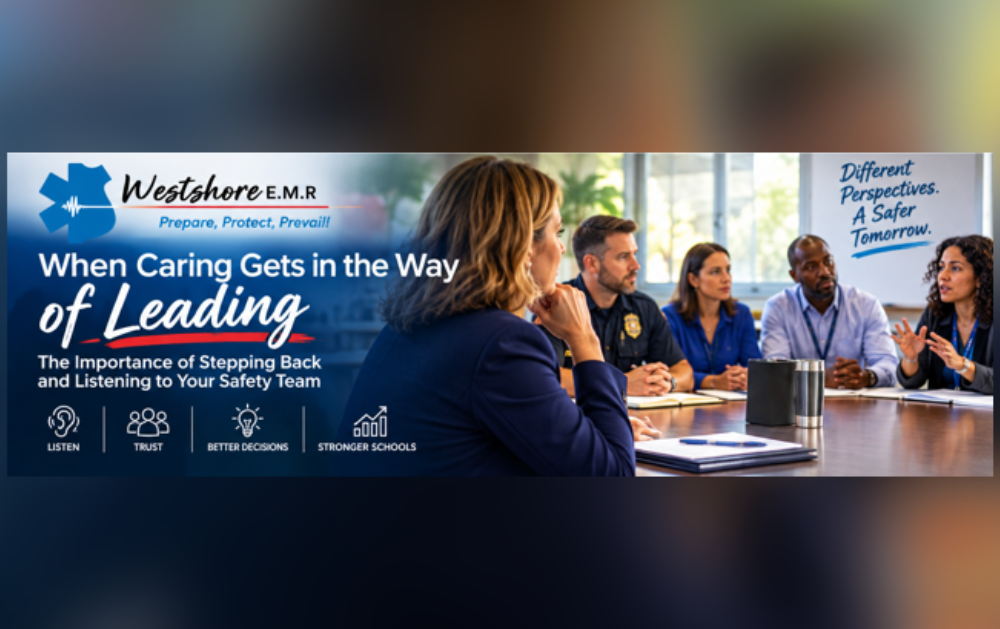
Safety Is a Team Sport
There is no single person responsible for school safety.
It is shared.
Leadership has a role.
Teachers have a role.
Staff have a role.
Students and families have a role.
Public safety partners have a role.
And safety professionals have a role.
When those groups communicate, listen to one another, and work toward the same objective, something important happens.
Safety becomes part of the culture rather than another item on a checklist.
And perhaps most importantly, the organization becomes capable of learning.
Because the goal isn’t to create a school that never experiences a problem.
That isn’t realistic.
The goal is to create a school that is prepared to recognize problems, respond to them, learn from them, and continually improve.
Leadership Is Knowing When to Step Back
Stepping back doesn’t mean giving up responsibility.
It means understanding your responsibility differently.
You are still the leader.
You are still accountable.
You still make the final decisions.
But you don’t have to make those decisions alone.
Surround yourself with people who understand the mission.
Listen to people who see things differently.
Ask questions.
Accept answers—even when they aren’t the answers you hoped to hear.
And when you’ve built a team you trust, give them the room to do what you asked them to do.
Because sometimes the strongest thing a leader can say isn’t:
“I know.”
It’s:
“I trust you. Show me what you’re seeing.”
At Westshore E.M.R., we believe safety is a partnership.
We don’t believe we have every answer, and we don’t believe an outside safety partner should.
Our responsibility is to listen, evaluate, share what we know, identify what we see, and work alongside the people who know their organization best.
Because safety isn’t about one person having all the answers.
It’s about bringing the right people together, listening to one another, and becoming better together.
And sometimes, the most important thing a leader can do is care enough to step back and trust the team they’ve built.